
2010-2012
Digital Signage and Biometric Solutions Consultant
Benetton Group
I led the engineering of Benetton Group's visionary digital transformation. Partnered with Panasonic and Canon's Developer Programs on cutting-edge 3D spatial scanning and computer vision technology, winning the Golden APEX Award at DSE 2012 in Las Vegas.
Highlights
- Golden APEX Award winner at Digital Signage Expo 2012
- 3D spatial scanning & depth-sensing technology integration
- Benetton Live Windows – interconnected videowall system
- Global flagship store deployments for LVMH & Benetton
- Real-time synchronized digital signage across continents
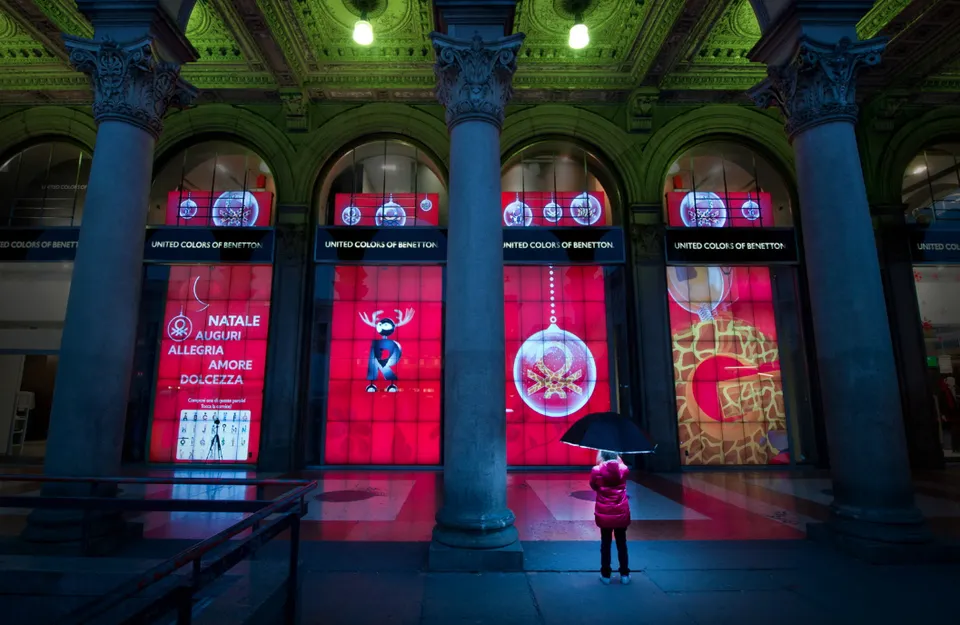
Fabrica, Benetton’s in-house creative laboratory, had a vision: transform store windows from static displays into living, intelligent spaces that engaged passersby through gesture, touch, and spatial awareness. My role was to engineer that vision into reality. I led a consultancy team providing R&D and prototype development, working hands-on across the full stack of emerging interaction technologies. This was the most hardware-intensive phase of my career. I was soldering circuits, experimenting with cutting-edge sensors, and integrating camera systems. The work fundamentally shaped how I think about the relationship between art and engineering.
The Creative Direction Meets Technical Reality
The partnership mirrored architecture and construction: Fabrica was the visionary architect, and our engineering team provided the structural engineering to make their ideas manifest. They designed experiences. We designed the systems to detect, measure, and respond to human presence and gesture with millisecond precision.
Fabrica’s creative ambition was boundless. Our constraint was physics. That tension produced something remarkable: technology that felt invisible because it was perfectly calibrated to human behavior rather than imposing restrictions on it.
Hardware-Software Integration at Scale
The technical challenges were formidable because so many of these technologies were simply immature in 2010-2012. We tackled problems across multiple emerging domains:
Natural Human Interfaces: We experimented with contactless interaction using 3D depth sensors from Panasonic’s Developer Program, eliminating the friction of physical touch while maintaining responsiveness. This required deep work with spatial recognition and gesture tracking: interpreting what a human intended from optical flow and skeletal data.
Visual Intelligence: We integrated optical flow analysis for gesture detection and face detection systems to understand store traffic patterns and adapt content to audience demographics. We partnered with Canon’s Developer Program for advanced camera integration and automation SDKs, gaining access to professional DSLR control and optimization capabilities for real-time flash and exposure compensation.
Multi-Sensory Recognition: Capacitive films embedded in the windows enabled multi-touch recognition through glass, while we interpolated multiple 3D depth maps simultaneously for floor mapping and human stance detection. This fusion of sensor data required novel approaches to signal processing and calibration.
Millisecond-Precision Synchronization: The Benetton Live Windows system comprised hundreds of high-definition displays distributed across flagship stores worldwide. Achieving synchronized content across multiple windows within the same store, across different cities, demanded careful architectural thinking about network topology, edge computing, and fault tolerance. Latency of a few milliseconds would break the illusion of a cohesive experience.
The Benetton Live Windows Vision
Benetton Live Windows was deployed across ten flagship stores globally: from New Delhi to Moscow, London to Shanghai. Rather than mannequins and printed signage, each window became a dynamic interface. Content wasn’t just product-focused. Fabrica curated social and topical themes alongside commercial messaging, inviting customers to participate in brand conversation rather than passively receive it.
Behind the scenes, our system continuously adapted. We monitored foot traffic patterns, detected crowd density, recognized when windows had engaged viewers. Content adjusted in real-time based on local conditions and audience demographics. The windows were alive in a way static retail had never achieved.
Golden APEX Award 2012
The Golden APEX Award at Digital Signage Expo 2012 in Las Vegas recognized what we had built: a seamless marriage of artistic vision and technical execution. The award wasn’t for the engineering alone or the creative direction alone. It was for the synthesis. It proved that when art and engineering collaborate as equals, the result transcends what either discipline could achieve independently.
Carrying the Lessons Forward
This experience crystallized something fundamental about technology’s role in human experience. The most powerful systems aren’t the ones with the most advanced features. They’re the ones that disappear into the background, responding so naturally to human intent that users forget they’re interacting with technology at all.
This early immersion in hardware-software co-design, embedded systems, and sensor fusion fueled a lasting passion for electronics, automation, and DIY experimentation. More importantly, it taught me that great engineering is never about technology for its own sake. It’s about deep empathy for the creative vision you’re enabling and the discipline to make that vision technically feasible.